The city is huge, and choosing the right neighbourhood can make the difference between an unforgettable year and months of endless commutes to campus and what to keep in mind before signing a contract. In this guide we’ll tell you first where to look for a room, then how to spot and avoid the scams that target students every year, and finally which are the best neighbourhoods to live in Madrid.
Where to look for accommodation?
We’ll tell you exactly where it’s worth focusing your efforts to find a flat quickly, without wasting time on places that won’t get you results.
WhatsApp groups
Many landlords also join WhatsApp groups to post their rooms, since they know they’ll find an audience made up almost entirely of Erasmus students looking for a flat, with no middlemen involved.
At Erasmus Touch, we’ve set up our own group so students and landlords can connect directly. Just join through the link, introduce yourself briefly, and let everyone know what you’re after (city, budget, dates…). From there, either someone will message you privately with an offer, or you’ll simply be kept in the loop in real time whenever a landlord posts a new listing.

Facebook groups
Most landlords who rent out on their own (without going through an agency) tend to be from an older generation, and that’s why they still mainly use Facebook groups to post their rooms. If you go to the Facebook search bar and type in keywords like rooms, erasmus, Madrid or students, you’ll find dozens of groups specifically dedicated to searching for and posting flats.
Here are a few to get you started right away, so you can post exactly what you’re looking for:
- Group 1: https://www.facebook.com/groups/3624403284497230
- Group 2: https://www.facebook.com/groups/219975687405925
- Group 3: https://www.facebook.com/groups/145601955087754
- Group 4: https://www.facebook.com/groups/1517189852032719

Idealista, Fotocasa and Milanuncios
The number one go to websites for finding a room in Spain. Here you’ll find hundreds of options available at any given time, from both private landlords and real estate agencies. You can filter by city, price, area and type of accommodation, so the whole process really just comes down to narrowing your search well and reaching out to whoever has what you need.
Get in touch with Ex-Erasmus students
Another source many people overlook: talk to students who already did their Erasmus in the city you’re heading to, especially if they’ve just finished theirs. They often have first hand information about flats becoming free right as they move out.
Search our Erasmus Touch group or our Instagram, or simply ask around in forums and chats from your own home university to see if anyone was already in that city the year before. A direct message asking «do you know if your flat is becoming free?» can save you weeks of searching, and gives you the peace of mind of renting something you already know about first-hand from someone who actually lived there.
At your own university
Don’t underestimate your university’s noticeboard (physical or online). Sometimes rooms get posted there directly by other students or local landlords, and in many cases the university has agreements with residences or agencies that give you access to accommodation already checked and verified by the institution itself, an extra layer of security against potential scams.
How to avoid scams when looking for a flat for your Erasmus
Can you imagine arriving in your Erasmus city convinced you had a room booked, only to discover it never actually existed? That would be a disaster, right? Luckily, most rental scams follow pretty recognisable patterns, so with a few minutes of common sense you can save yourself a lot of stress (and money). Here’s everything you need to arrive at your new city with peace of mind.
Warning signs: when to be suspicious
About the landlord or agency
First things first, make sure you’re actually talking to a real person or a real agency. Don’t be afraid to ask for details or look up who’s on the other end. On Facebook, be especially wary of recently created profiles with photos that look faker than a €30 note.
About the flat or room
- The price is too good to be true. A central, renovated, bright room priced way below the average for the area is almost never a bargain: it’s the bait. Always compare with other rooms in the same neighbourhood before getting too excited.
- They rush you. «I’ve got someone else interested,» «if you don’t book today you’ll lose it»… Urgency is any scammer’s favourite tool, precisely so you don’t stop to think or verify anything.
- They ask for money before you’ve seen the room. A deposit, a «booking fee,» or a «down payment» upfront, without having stepped foot in the flat or signed anything. This is the classic scam: you pay, and the person disappears.
- The «owner» is abroad. One of the most repeated stories: they say they’re away for work, can’t show you the place in person, and will send you the keys by courier as soon as you pay. That courier never arrives, because it never existed.
- They want to take the conversation off the platform. If the moment you make contact they push to move straight to WhatsApp, Telegram or email to «speed things up,» be cautious. Outside the original listing site there’s no trace of the conversation left, and it’s much easier for them to block you once they’ve been paid.
- They ask for personal details too early. A copy of your ID, payslips or bank details right at the start of the conversation, before you’ve seen anything at all. They might not even be trying to rent you a flat, they could be after your identity.
- Fake real estate agencies. Individuals posing as an agency who charge you to «give you access» to a list of rooms or to «manage» your booking. A legitimate agency has a physical office, is officially registered, and never charges the tenant just to show them flats.
How to verify a listing is real
Before paying a single euro, spend ten minutes checking that both the room and the person actually exist. This is exactly what makes the difference between a smooth Erasmus and a serious problem.
Go see it in person (or on a live video call)
Ideally, always visit the room before committing to anything. If you can’t go in person because you’re still in your home country, ask for a live video call where the person shows you the room, the rest of the flat, and the view from the window right there and then. Ask them to move the camera wherever you want. Scammers usually dodge this with some excuse or another, simply because they don’t actually have the flat.
Check the address and the photos
Put the address into Google Maps and look at it on Street View: does the building’s façade match the photos in the listing? Then run a reverse image search (you can drag the photo straight into Google Images). If those same photos show up in listings for other cities or on furniture-selling websites, it’s a scam built with stolen photos.
Look for a trace of the person and the listing
A recently created account, with no history and no other listings, is far less trustworthy than a profile with some track record. And if you found the room through a website, search the person’s or agency’s name on Google alongside words like «reviews» or «scam» to see if anyone else has run into trouble before you.
Ask for a contract
A serious rental gets signed, no exceptions. If the person refuses to sign a tenancy or room rental agreement, or keeps dodging it, don’t go any further. The contract is your legal protection, and knowing your rights as a tenant before signing will save you a lot of headaches down the line.
The golden rule with payments
If you take away just one thing from this whole guide, make it this:
Never pay for a room you haven’t seen, under a contract you haven’t signed.
And within that rule, pay attention to how you pay too:
- Be wary of anyone demanding payment via Bizum, bank transfer, Western Union or cryptocurrency to a stranger. These are fast, irreversible methods: once the money’s sent, getting it back is next to impossible.
- A deposit is completely normal when signing the contract, with the keys already in your hand, not before, and definitely not to someone you don’t even know is the actual owner.
What types of student accommodation are there in Madrid?
Before choosing an area, it’s important to know what Erasmus accommodation options in Madrid exist:
- Shared flat in Madrid: the most popular choice among international students. The price of a room in a shared flat ranges from €400 to €850 a month, usually with bills included.
- Studio apartments: for those who prefer complete privacy. Price between €700 and €1,600/month. There’s less availability than shared rooms.
- Student residences in Madrid: the all-inclusive option (meals, cleaning, social atmosphere). Price between €850 and €1,650/month.
- Homestay with a Spanish family: ideal for language and cultural immersion. Price between €350 and €550/month, though with less freedom around schedules.
Student rent prices in Madrid city centre
In central Madrid, the average price of a room ranges from €450 to €800 a month, depending on the neighbourhood and whether utilities (electricity, water, internet) are included or not. It’s essential to confirm this before signing any rental contract.
What to check before renting a flat in Madrid as an Erasmus student
- Deposit: the amount, how it’s paid, and the conditions for getting it back. If you rent through an agency, keep in mind there’s usually a non refundable agency fee.
- Contract length: exact move-in and move-out dates, and subletting terms in case you need to hand your room over to someone else.
- House rules: quiet hours, visitor policy, and any other flat limitations.
- Location and transport: distance to campus and to supermarkets.
- Bills included: always ask whether electricity, water and internet are billed separately from the rent.
Start looking for a flat early: demand for student housing in Madrid spikes between August and February, so the sooner you start searching, the better options you’ll have available.
The best neighbourhoods for students in Madrid
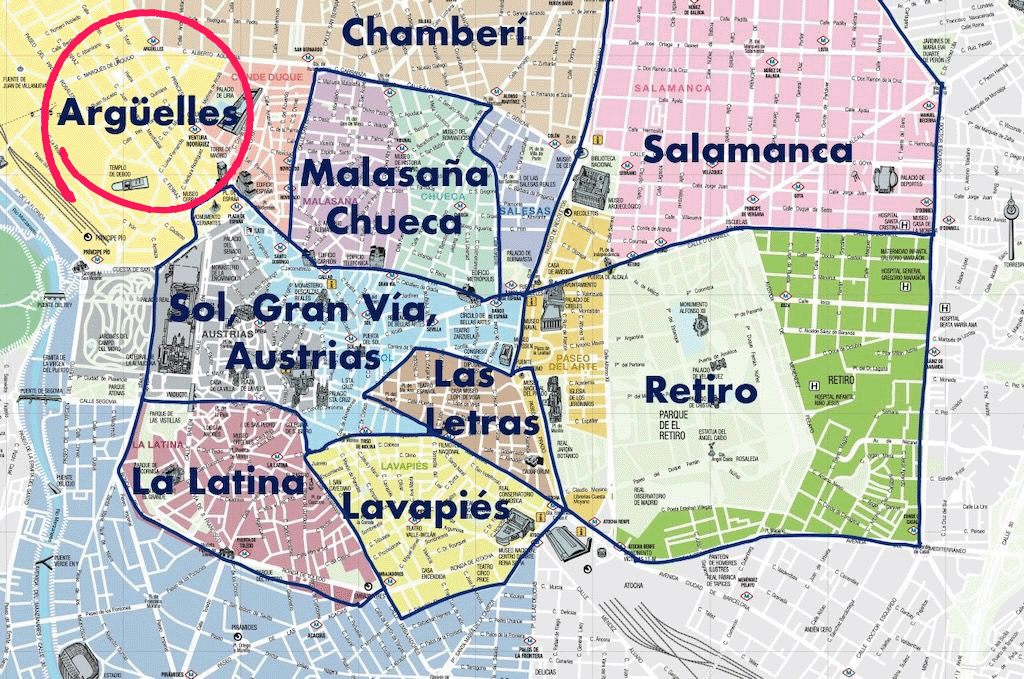
Moncloa / Argüelles: Madrid’s university neighbourhood
Moncloa and Argüelles are, without a doubt, the best area to live in Madrid as a student. This is where Ciudad Universitaria is located, home to the campuses of Universidad Complutense de Madrid (the largest and best-known public university in the country), Universidad Politécnica de Madrid, and universities like CEU or Francisco de Vitoria. The result: thousands of students living in the area and a very active university atmosphere all year round.
There’s a wide, affordable range of bars and cafés, and most of Madrid’s student residences and colegios mayores are located here. To unwind, Parque del Oeste is perfect for a walk or some exercise, and the Temple of Debod (a genuine Egyptian temple) is a must for spectacular sunsets. The Princesa area, between Plaza de España and Moncloa, adds several tourist attractions on top of that.
Transport: metro line 3 and Circular, plus numerous bus lines. 15-20 minutes by metro (4-5 stops) from the centre, and right next to Malasaña and Chueca.
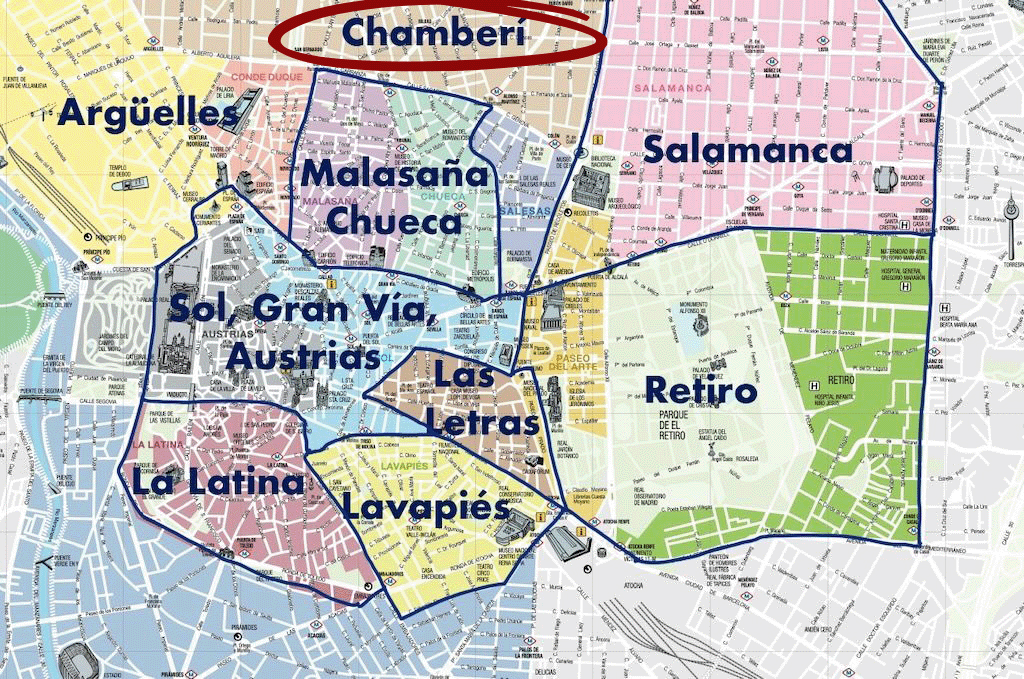
Chamberí: a quiet, well-connected neighbourhood for students
Chamberí is another of the best areas to live in Madrid as a student, especially if you want peace and quiet without giving up closeness to the centre and Ciudad Universitaria. It’s more residential than its neighbours, with standout architecture — buildings like the Sorolla Museum or the Instituto Internacional, and a solid cultural scene: theatres, cinemas, gyms and museums.
Students tend to gather at Plaza de Olavide, one of the best spots for tapas in Madrid, as well as Plaza de Chamberí. It may look quiet by day, but it has plenty of nightclubs after dark. The downside: not many green spaces of its own, though Parque del Oeste and Parque Tercer Depósito are close by for outdoor exercise.
Transport: metro lines 2, 5, 6, 7, 8, 10 and Circular, plus Nuevos Ministerios train station.
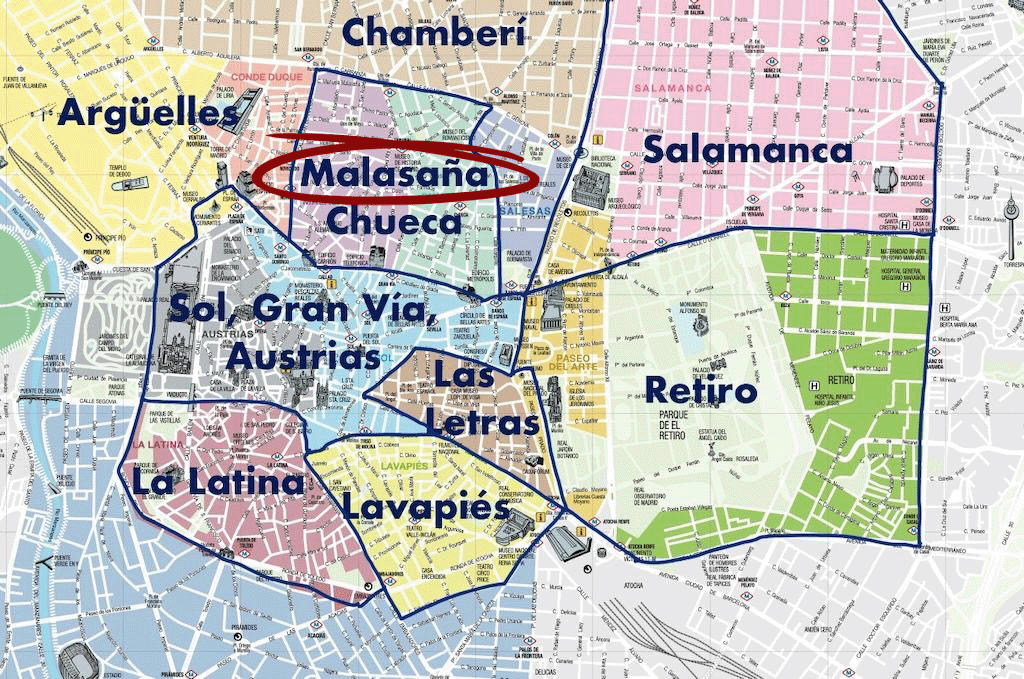
Malasaña: the most alternative neighbourhood for university students
Malasaña is known as Madrid’s liveliest student neighbourhood, and also the city’s most alternative. Its main street, Fuencarral, is packed with shops, bars, restaurants and clubs, running parallel to Calle Hortaleza, which makes Malasaña and Chueca practically neighbours.
Plaza del Dos de Mayo is the ultimate student meeting point (especially on Saturdays), and it has history too: this is where the 1808 battle against Napoleon’s troops was fought. Today it’s surrounded by terraces and cafés.
The neighbourhood is the historic birthplace of «la Movida Madrileña,» the cultural movement that exploded after Franco’s dictatorship in the late ’70s and left a lasting mark: nowadays it blends graffiti and an underground vibe with vintage shops, tattoo studios and live music venues. There are also some interesting museums nearby, like the ABC Museum, the Municipal Museum of Contemporary Art, or the Palacio de Liria, plus some buildings belonging to Universidad Pontificia de Comillas.
Transport: metro lines 2, 3, 4, 6 and 10. From here you can walk to Gran Vía, Plaza Mayor or Puerta de Alcalá.
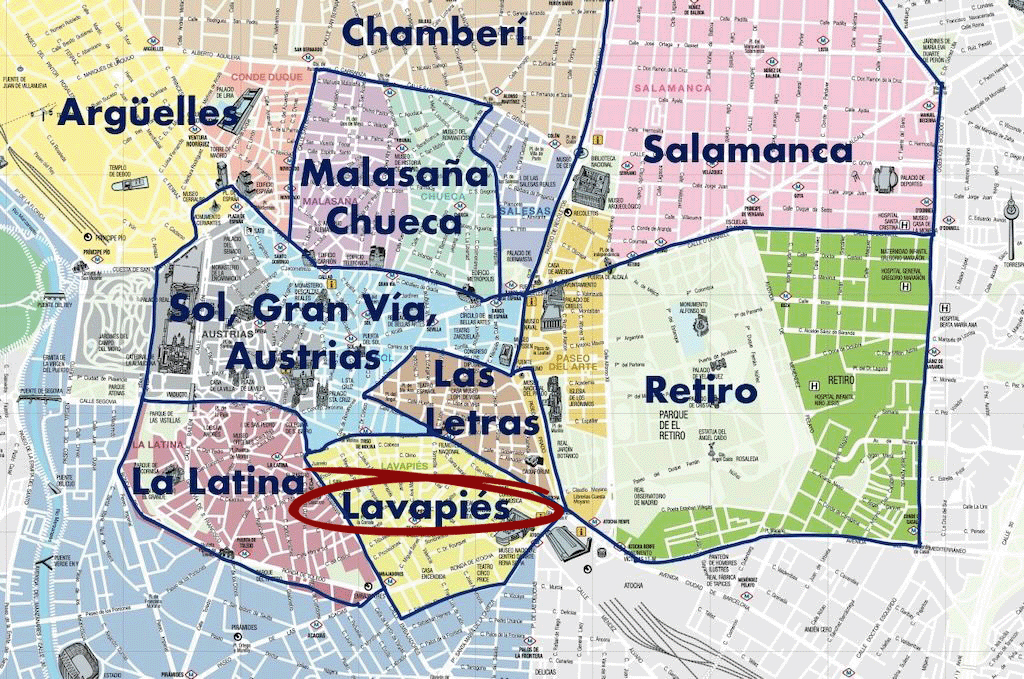
Lavapiés: affordable, multicultural accommodation for Erasmus students
If you’re after cheap student accommodation in Madrid, Lavapiés is one of the best options within the centre. It’s the city’s most multicultural neighbourhood, shaped by decades of African and Middle Eastern communities, which translates into spectacular international food (the Indian restaurants here are some of the best in Madrid) and a distinctive alternative nightlife.
It’s just one stop from Sol, close to the Reina Sofía Museum, and one of the most affordable areas to rent in the centre. It has several international markets, like Antón Martín or San Fernando, and it’s very close to Universidad Carlos III de Madrid’s Puerta de Toledo campus.
Transport: metro lines 1 and 3, and a short walk from Atocha station, which connects to the rest of Spain.
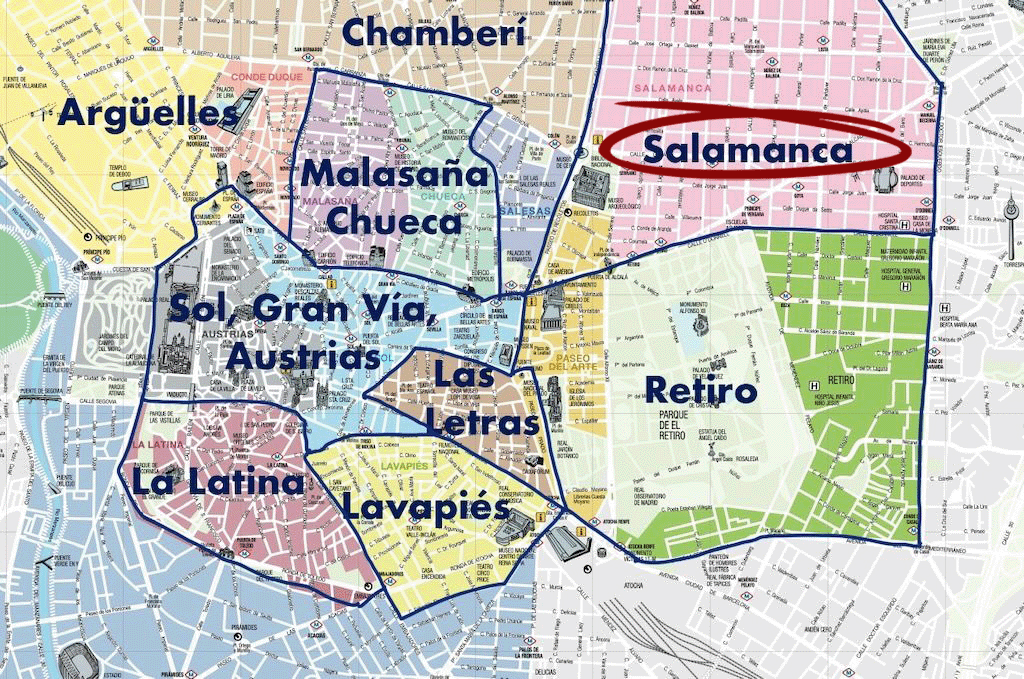
Salamanca: Madrid’s most exclusive neighbourhood
Salamanca is the city’s most upscale, elegant area, with designer shops along its main streets, Serrano and Velázquez, right above Retiro Park. It’s quite a bit quieter than other neighbourhoods, with high-end restaurants and select nightlife spots, though it still keeps its local shops and old-school bars too. Rental prices are among the highest in Madrid, so it’s an area worth considering only if your budget allows for it.
Chueca: nightlife and LGBTQ+ vibe right in the centre
Chueca has been Madrid’s LGBTQ+ capital for over two decades and is one of the best nightlife areas for students. Its main street, Hortaleza, is lined with restaurants, terraces and the Mercado de San Antón, a gourmet market with a very popular rooftop. By night it’s home to some of the city’s liveliest clubs and bars, and it also hosts one of the biggest Pride celebrations in the world.
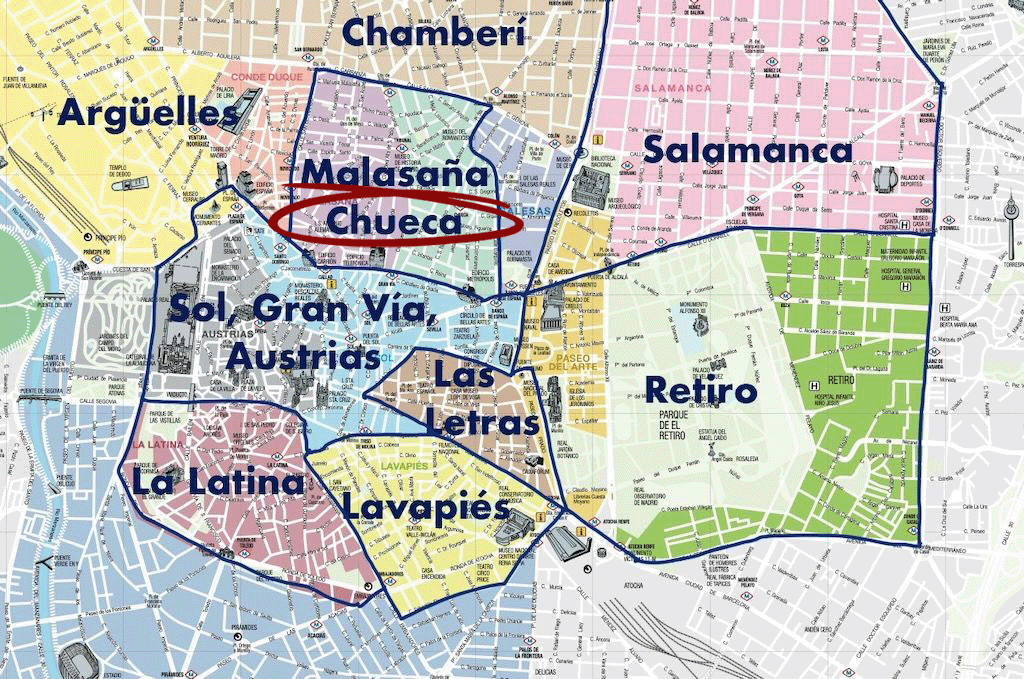
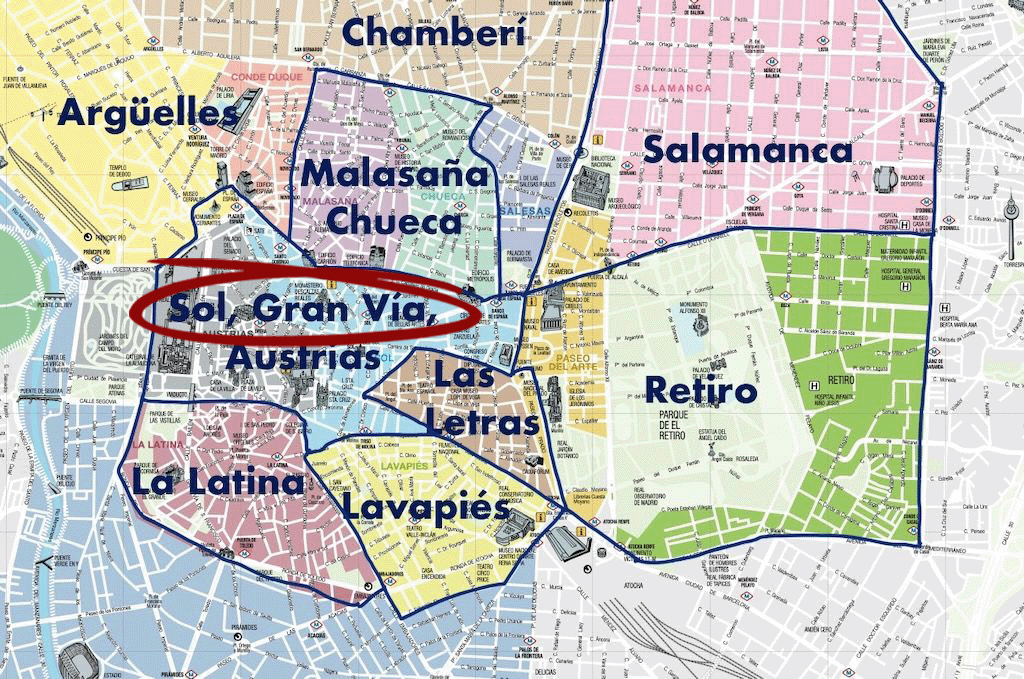
Sol: the beating heart of Madrid
Puerta del Sol is the tourist and commercial heart of the capital, with the iconic Bear and Strawberry Tree statue as the symbol of Madrid. It’s the best-connected area in the whole city, packed with shops, tapas bars and terraces everywhere you look. It’s always buzzing, between bars, clubs and cafés.
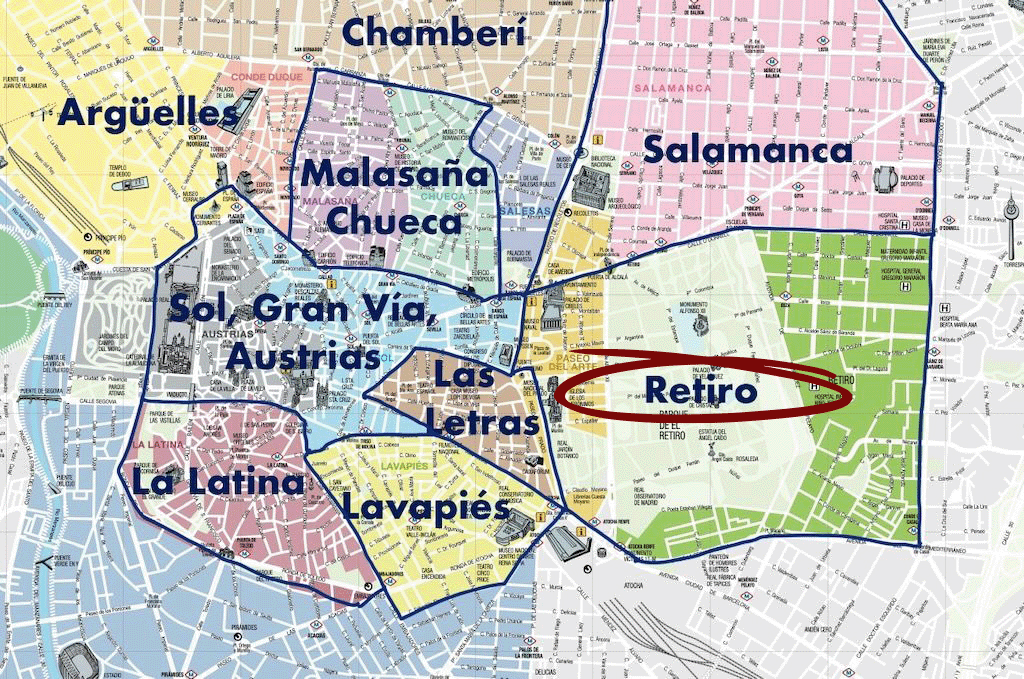
Retiro: the quiet, green option for students
If you’d rather live surrounded by nature, Retiro is your neighbourhood. The park it’s named after — Madrid’s «Central Park» — offers plenty of room to run, cycle or simply unwind, with highlights like the lake, the Palacio de Cristal, or the rose gardens. There are also free activities like bootcamp classes, roller skating, or yoga. It’s one of the quietest areas in the city, ideal if you want to leave the urban noise behind without straying too far from the centre.
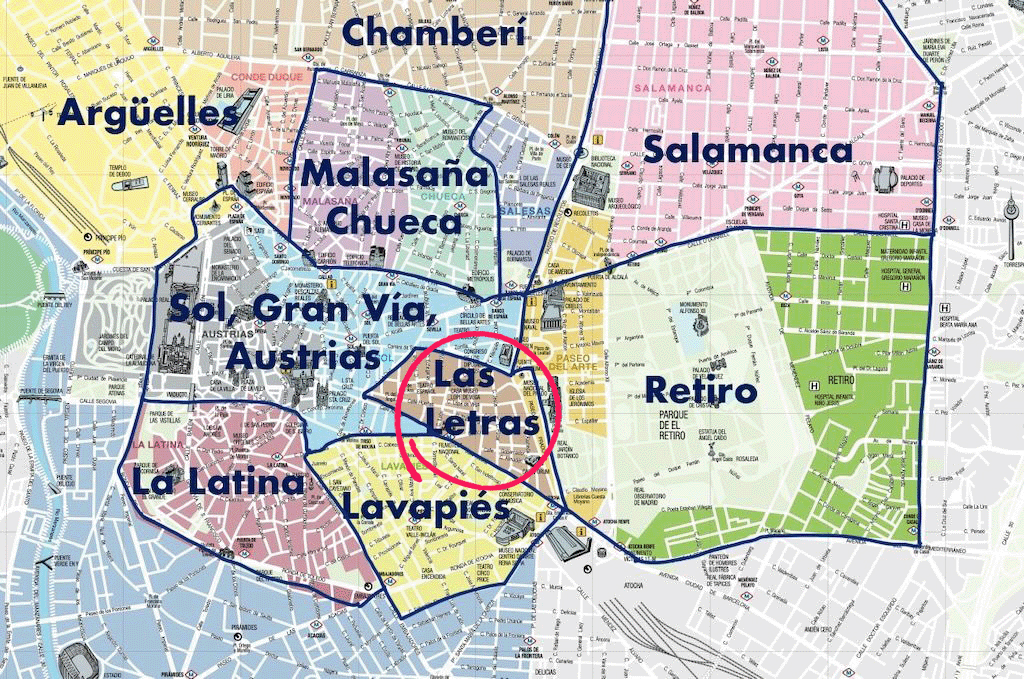
Huertas / Barrio de las Letras: tapas and cultural life
Just a 5-minute walk from Sol, Huertas (also known as Barrio de las Letras) combines some of Madrid’s best tapas bars with a strong cultural and gastronomic scene. Keep walking down Calle Huertas and you’ll reach Paseo del Prado, home to the city’s major museums, making this neighbourhood a great plan both by day and before a night out.