Barcelona is huge, and choosing the right neighbourhood can be the difference between spending half your life on the metro or having your day to day sorted in 20 minutes. In this guide we’ll tell you where to look for a room, how to spot and avoid the scams that target students every year, and which are the best neighbourhoods to live in as a student in Barcelona.
Where to look for accommodation?
We’ll tell you exactly where it’s worth focusing your efforts to find a flat quickly, without wasting time on places that won’t get you results.
WhatsApp groups
Many landlords also join WhatsApp groups to post their rooms, since they know they’ll find an audience made up almost entirely of Erasmus students looking for a flat, with no middlemen involved.
At Erasmus Touch, we’ve set up our own group so students and landlords can connect directly. Just join through the link, introduce yourself briefly, and let everyone know what you’re after (city, budget, dates…). From there, either someone will message you privately with an offer, or you’ll simply be kept in the loop in real time whenever a landlord posts a new listing.
👉 Join the Housing Barcelona group

Facebook groups
Most landlords who rent out on their own (without going through an agency) tend to be from an older generation, and that’s why they still mainly use Facebook groups to post their rooms. If you go to the Facebook search bar and type in keywords like rooms, erasmus, Barcelona or students, you’ll find dozens of groups specifically dedicated to searching for and posting flats.
Here are a few to get you started right away, so you can post exactly what you’re looking for:
- Group 1: https://www.facebook.com/groups/3624403284497230
- Group 2: https://www.facebook.com/groups/219975687405925
- Group 3: https://www.facebook.com/groups/145601955087754

Idealista, Fotocasa and Milanuncios
The number one go-to websites for finding a room in Spain. Here you’ll find hundreds of options available at any given time, from both private landlords and real estate agencies. You can filter by city, price, area and type of accommodation, so the whole process really just comes down to narrowing your search well and reaching out to whoever has what you need.
Get in touch with Ex-Erasmus students
Another source many people overlook: talk to students who already did their Erasmus in the city you’re heading to, especially if they’ve just finished theirs. They often have first-hand information about flats becoming free right as they move out.
Search our Erasmus Touch group or our Instagram, or simply ask around in forums and chats from your own home university to see if anyone was already in that city the year before. A direct message asking «do you know if your flat is becoming free?» can save you weeks of searching, and gives you the peace of mind of renting something you already know about first hand from someone who actually lived there.
At your own university
Don’t underestimate your university’s noticeboard (physical or online). Sometimes rooms get posted there directly by other students or local landlords, and in many cases the university has agreements with residences or agencies that give you access to accommodation already checked and verified by the institution itself, an extra layer of security against potential scams.
How to avoid scams when looking for a flat for your Erasmus
Can you imagine arriving in your Erasmus city convinced you had a room booked, only to discover it never actually existed? That would be a disaster, right? Luckily, most rental scams follow pretty recognisable patterns, so with a few minutes of common sense you can save yourself a lot of stress (and money). Here’s everything you need to arrive at your new city with peace of mind.
Warning signs: when to be suspicious
About the landlord or agency
First things first, make sure you’re actually talking to a real person or a real agency. Don’t be afraid to ask for details or look up who’s on the other end. On Facebook, be especially wary of recently created profiles with photos that look faker than a €30 note.
About the flat or room
- The price is too good to be true. A central, renovated, bright room priced way below the average for the area is almost never a bargain: it’s the bait. Always compare with other rooms in the same neighbourhood before getting too excited.
- They rush you. «I’ve got someone else interested,» «if you don’t book today you’ll lose it»… Urgency is any scammer’s favourite tool, precisely so you don’t stop to think or verify anything.
- They ask for money before you’ve seen the room. A deposit, a «booking fee,» or a «down payment» upfront, without having stepped foot in the flat or signed anything. This is the classic scam: you pay, and the person disappears.
- The «owner» is abroad. One of the most repeated stories: they say they’re away for work, can’t show you the place in person, and will send you the keys by courier as soon as you pay. That courier never arrives, because it never existed.
- They want to take the conversation off the platform. If the moment you make contact they push to move straight to WhatsApp, Telegram or email to «speed things up,» be cautious. Outside the original listing site there’s no trace of the conversation left, and it’s much easier for them to block you once they’ve been paid.
- They ask for personal details too early. A copy of your ID, payslips or bank details right at the start of the conversation, before you’ve seen anything at all. They might not even be trying to rent you a flat, they could be after your identity.
- Fake real estate agencies. Individuals posing as an agency who charge you to «give you access» to a list of rooms or to «manage» your booking. A legitimate agency has a physical office, is officially registered, and never charges the tenant just to show them flats.
How to verify a listing is real
Before paying a single euro, spend ten minutes checking that both the room and the person actually exist. This is exactly what makes the difference between a smooth Erasmus and a serious problem.
Go see it in person (or on a live video call)
Ideally, always visit the room before committing to anything. If you can’t go in person because you’re still in your home country, ask for a live video call where the person shows you the room, the rest of the flat, and the view from the window right there and then. Ask them to move the camera wherever you want. Scammers usually dodge this with some excuse or another, simply because they don’t actually have the flat.
Check the address and the photos
Put the address into Google Maps and look at it on Street View: does the building’s façade match the photos in the listing? Then run a reverse image search (you can drag the photo straight into Google Images). If those same photos show up in listings for other cities or on furniture selling websites, it’s a scam built with stolen photos.
Look for a trace of the person and the listing
A recently created account, with no history and no other listings, is far less trustworthy than a profile with some track record. And if you found the room through a website, search the person’s or agency’s name on Google alongside words like «reviews» or «scam» to see if anyone else has run into trouble before you.
Ask for a contract
A serious rental gets signed, no exceptions. If the person refuses to sign a tenancy or room rental agreement, or keeps dodging it, don’t go any further. The contract is your legal protection, and knowing your rights as a tenant before signing will save you a lot of headaches down the line.
The golden rule with payments
If you take away just one thing from this whole guide, make it this:
Never pay for a room you haven’t seen, under a contract you haven’t signed.
And within that rule, pay attention to how you pay too:
- Be wary of anyone demanding payment via Bizum, bank transfer, Western Union or cryptocurrency to a stranger. These are fast, irreversible methods: once the money’s sent, getting it back is next to impossible.
- A deposit is completely normal when signing the contract, with the keys already in your hand, not before, and definitely not to someone you don’t even know is the actual owner.
First things first: think about transport, not just the «trendy» neighbourhood
When someone looks for a flat in Barcelona as a student, the natural instinct is to focus on the prettiest or coolest neighbourhood first. But for actual university life, what really matters is a much more boring (and much more useful) question: how long does it take door to door to get to class?
Barcelona gets around great by metro, bus and tram, but there’s a common trap: two areas can look close on the map and still involve annoying transfers or long journeys. So before falling in love with a neighbourhood, run through these quick checks:
- Pinpoint your exact campus: many universities have buildings spread across different districts, so note the specific address you’ll be heading to most days.
- Check the real commute at rush hour: don’t settle for a generic «20 minutes» on Google Maps. Check the route on a Monday at 8:00-9:00 a.m. and the return trip at 6:00-7:00 p.m.
- Fewer transfers is better: a route with a single direct metro line is usually more comfortable than one that’s «faster on paper» but involves two changes.
- Don’t forget the «last stretch»: that final walk from the stop to your door, at night or in the rain, matters too. Well lit, lively streets help a lot.
📌 Generally speaking, if you can land a stable 25-35 minute door-to-door commute, your academic life becomes a lot easier. Less time on transport means more time for studying, working out, or just relaxing (or the beach, since that’s what you’re in Barcelona for, after all).
The best neighbourhoods for students in Barcelona
Eixample: central, well connected, but watch your budget
Eixample (both Dreta and Esquerra) is one of the most popular neighbourhoods among students, and it’s no surprise why. Here you’ll find an almost endless supply of bars, restaurants, shops, gyms and cultural life, with Passeig de Gràcia, Sagrada Família or Rambla de Catalunya as local landmarks.
The only downside is that green spaces are scarce, though Parc de la Ciutadella and the beach are relatively close by. As for transport, it’s got plenty: several metro lines, buses, trams, and even FGC (Catalan Railways) and train stops, ideal if your university is on the outskirts, like the Autònoma in Bellaterra.
Worth noting: prices here tend to be among the highest in the city, and flat quality varies a lot (from old, unrenovated buildings to fully refurbished flats), so double check the conditions carefully before signing anything.
Zona Universitària de Les Corts: the obvious choice if you study nearby
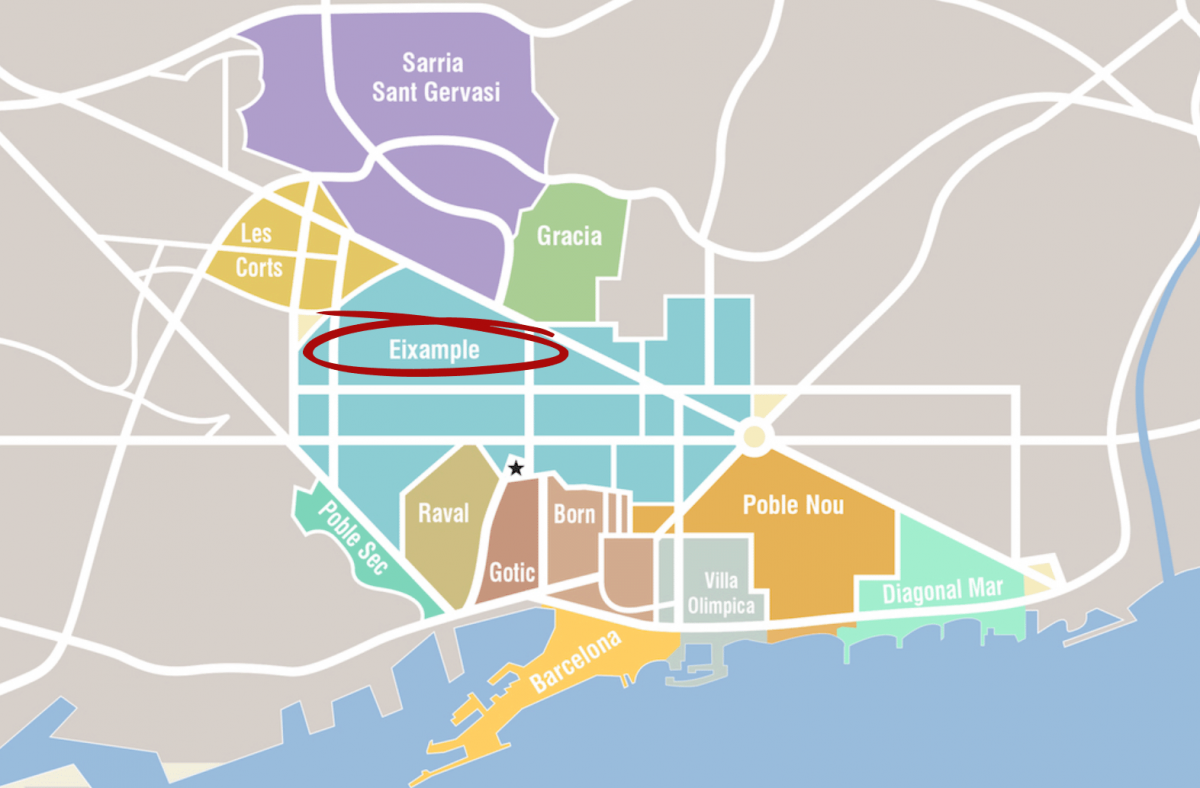
Living here makes a lot of sense if you’re studying at one of the institutions with a campus in the area, such as the Universitat de Barcelona, the UPC, or Esade. The downside is that it’s quite far from both the city centre and the beach, so this area suits people who want to focus on academic life without too many distractions. As an upside, being a bit further out, you sometimes find accommodation slightly cheaper than in more central areas.
Along Avinguda Diagonal you’ll find plenty of shops and restaurants (though not exactly the cheapest for a student budget), and the L’Illa shopping centre is here too. What Les Corts does have plenty of is green space that other neighbourhoods would kill for: Parc de Pedralbes, Parc de Cervantes, or the Jardins de la Maternitat. And nearby you’ve also got Camp Nou, the Palau Reial de Pedralbes, and the Monestir de Pedralbes.
Transport: very well connected by bus, tram, and metro lines L3, L5 and L9S.
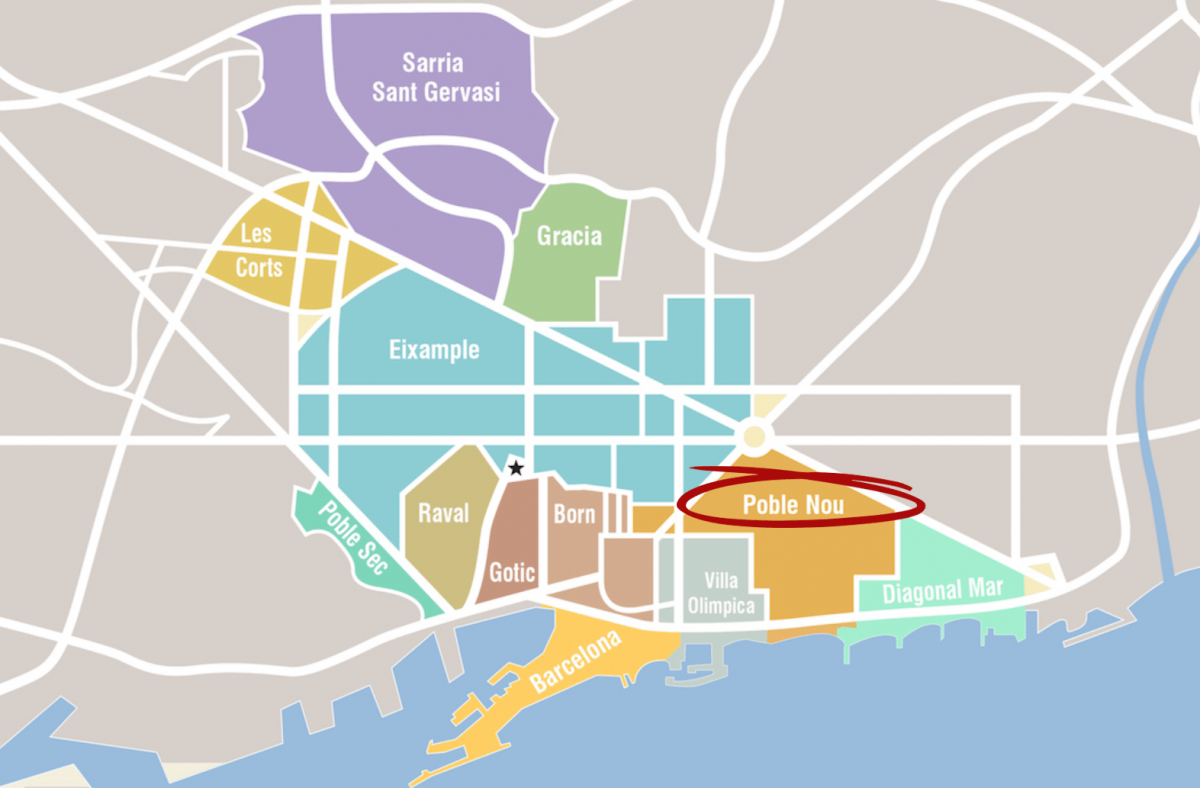
El Poblenou: the neighbourhood that mixes converted factories with beach life
Poblenou has undergone a massive transformation in recent years: from an industrial area to one of the most sought after neighbourhoods in the city, with an atmosphere that blends tradition and modernity in a pretty unique way. It’s more residential and quieter than other central areas, so if you prefer somewhere with less noise but still plenty of life, this is a great option.
It’s the perfect area, for example, if you’re studying at the Poblenou Campus of Universitat Pompeu Fabra. Rambla del Poblenou concentrates much of the bar and restaurant scene, many at pretty reasonable prices (since it’s not as touristy as other areas). Culturally, there are several theatres, museums and art centres, like the Centre d’Arts Digitals IDEAL, and for nightlife, this is home to the legendary Razzmatazz club.
And the big draw: the beach is basically right there. In fact, these are the beaches favoured by actual Barcelona residents, away from the more touristy vibe of Barceloneta. For green spaces, you’ve got Parc del Centre del Poblenou and Parc del Poblenou.
Transport: although it’s a bit further from the centre, it’s well connected via several tram, bus and metro lines.
La Vila de Gràcia: the locals’ favourite
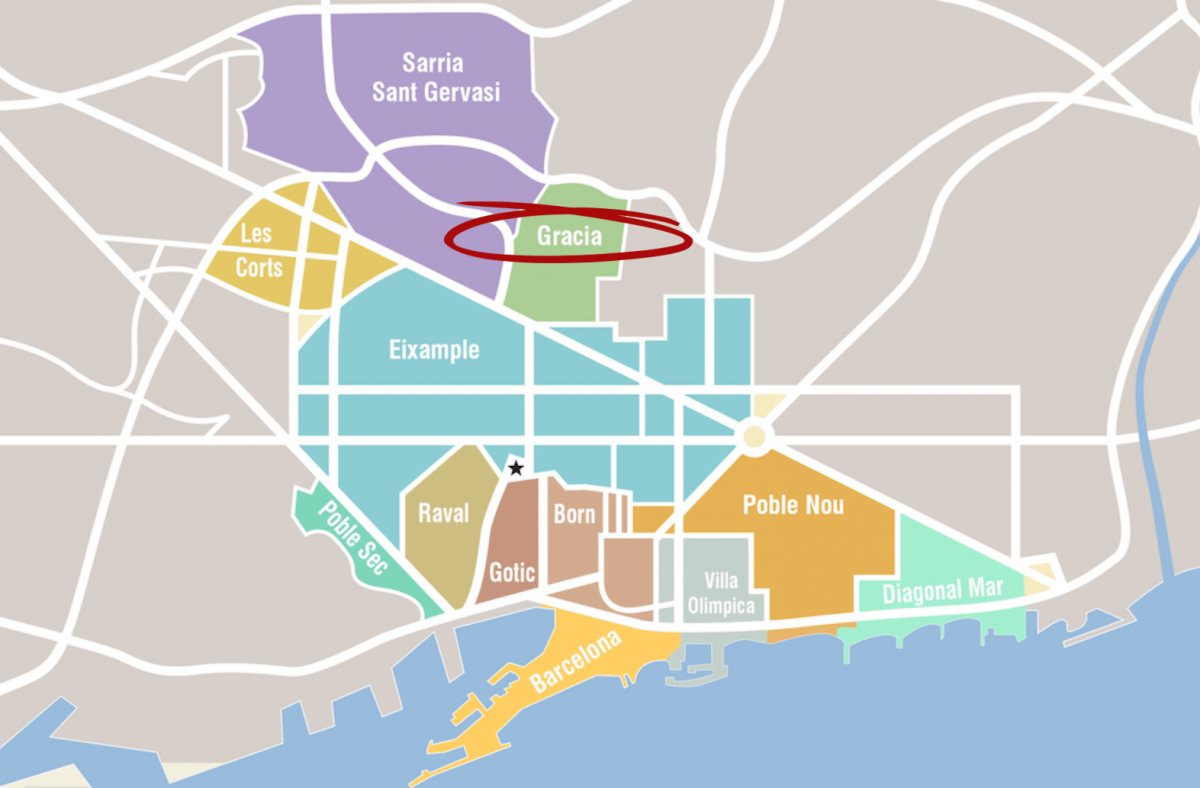
Gràcia is one of those neighbourhoods that wins you over at first sight, largely for keeping that «village within the city» feel, with lots of pedestrian streets and a genuinely authentic vibe. You’ll find everything here: bars, restaurants, small shops, theatres, cinemas… and a nightlife scene that revolves around its squares, especially Plaça de la Vila de Gràcia and Plaça del Sol.
For a cultural visit, there’s Gaudí’s Casa Vicens (the first residential house the architect ever designed) and Hotel Casa Fuster. The downside: there’s hardly any real green space, beyond the occasional square.
Transport: a bit of a heads up here, public transport is mostly concentrated on the main streets surrounding the neighbourhood, so it’s worth double-checking the specific connection to your destination before committing.
Sants: the city’s transport hub
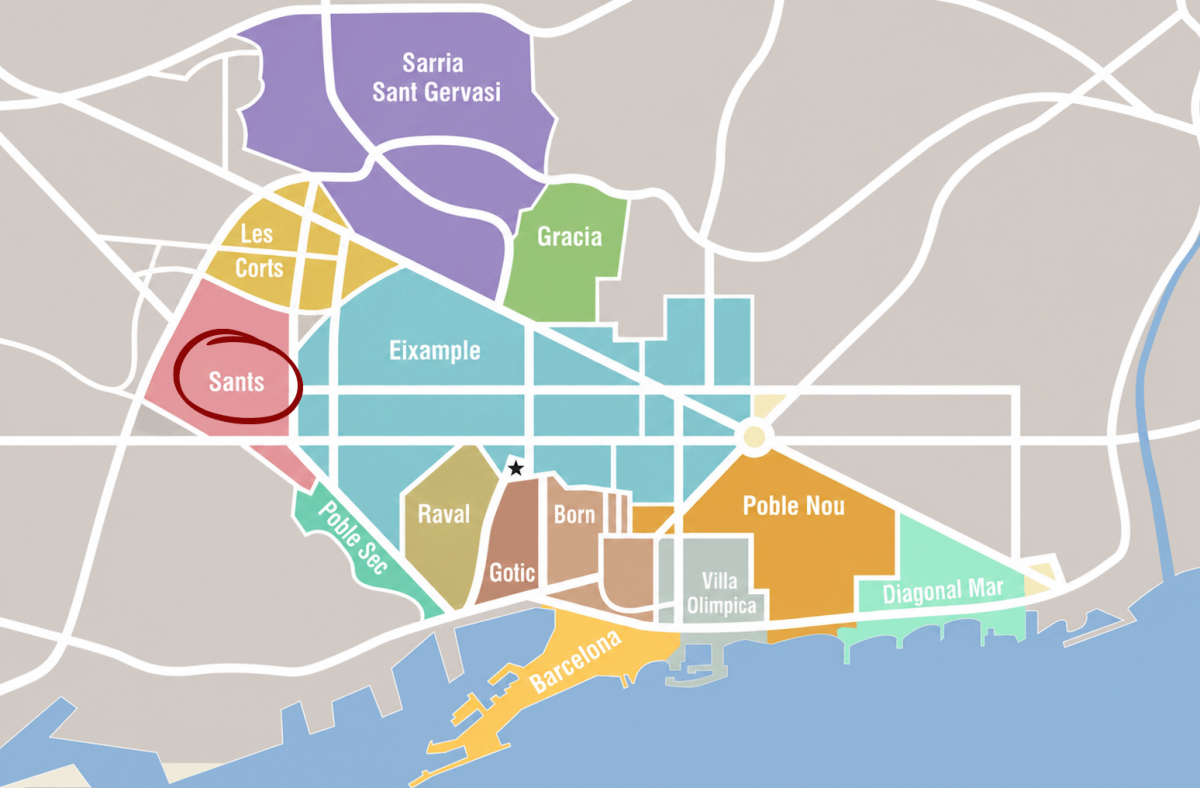
Sants is, quite literally, one of Barcelona’s most important transport hubs (with its own train station), which makes it a very practical option if your day-to-day revolves around the western side of the city. It’s not the most «postcard worthy» neighbourhood for sightseeing, but for studying and getting around easily, that low-key character works in its favour.
Transport: highly efficient mobility thanks to the station and the many lines running through it. That said, the nightlife tends to be quieter than in other areas (perfect for some, maybe a bit too calm for others).
How to choose well using the metro and bus (quick method)
If you’re torn between two or three neighbourhoods, this method can save you quite a headache:
- Pick 3 reference points: your campus, your usual library (or the city centre), and somewhere you care about for leisure (gym, beach, etc.).
- Calculate times for two time slots: morning (8:00-9:00 a.m.) and evening (6:00-7:00 p.m.).
- Note the transfers: every change adds friction. Sometimes an option that’s 10 minutes longer but direct is worth it over the «faster» one with transfers.
- Check your plan B: if the metro fails one day, do you have a direct bus or a nearby alternative?
A real-world example: if a flat in Gràcia means combining metro and bus to get to class, but one in Sants means a single line plus a short walk, the second option usually feels a lot more stable day to day, even if the neighbourhood excites you less at first.
Student residence vs. shared flat: what matters most when you’re new to Barcelona
A shared flat is a perfectly valid option, especially if you already know the city or have plenty of time to view flats, negotiate, and filter through listings. The problem is that if you’re arriving for the first time (especially from abroad), the search can end up being exhausting: rushed viewings, high competition for every room, deposits, guarantors, and costs that aren’t always clear from day one.
That’s why many students opt for a student residence, at least for the first year: you usually get 24 hour security, communal study spaces, an international community from day one, maintenance included, and a much more predictable cost than a typical shared flat.
- If you want peace of mind and routine: go for a residence near a metro line that connects well to your campus.
- If you want total independence: a shared flat, but with a very clear contract and cost breakdown from the start.
- If you’re coming from abroad: it’s often worth starting with a more «all-in-one» solution for the first semester and deciding later, once settled, whether to move.
Final tips so you don’t overpay just to «be close»
Barcelona rewards those who choose with their head, not just their heart. Being right next to the centre doesn’t always mean a shorter commute to class, and a more peripheral neighbourhood can be incredibly convenient if it’s well connected.
- Prioritise a direct line to your campus, even if the neighbourhood isn’t the most Instagram-famous.
- Look at everyday life: supermarkets, laundrette, libraries, places to run or walk. That matters far more day to day than having a nice landmark around the corner.
- Don’t idealise the flat: between deposit, utilities and admin fees, the real cost can climb quite a bit above the advertised price. In a residence, that part is usually already sorted for you.
- Do a visit «as a student would»: try the commute at the time you’d actually be heading to class, and come back at dusk. It’ll give you a far more realistic picture than a weekend midday visit.
If you had to stick to just one criterion, make it this: choose the area that guarantees consistency, same times, few changes, some backup if something goes wrong. During exam season, that stability is worth its weight in gold.